Rows: 485
Columns: 14
$ HV1        <dbl> 5, 4, 5, 5, 4, 5, 4, 5, 4, 4, 5, 4, 5, 2, 4, 4, 5, 5, 4, 4,…
$ HV2        <dbl> 5, 4, 4, 5, 4, 4, 4, 4, 5, 4, 5, 4, 5, 2, 4, 4, 5, 5, 5, 4,…
$ HV3        <dbl> 5, 4, 5, 4, 4, 5, 4, 4, 4, 3, 5, 4, 5, 2, 4, 4, 5, 5, 4, 4,…
$ HV4        <dbl> 5, 4, 5, 5, 4, 5, 4, 5, 5, 4, 5, 4, 5, 2, 3, 4, 4, 4, 4, 5,…
$ PMB1       <dbl> 4, 4, 4, 4, 5, 4, 3, 4, 4, 4, 4, 4, 4, 3, 4, 4, 4, 5, 5, 4,…
$ PMB2       <dbl> 4, 4, 4, 4, 4, 4, 3, 4, 4, 4, 4, 4, 4, 3, 3, 4, 3, 4, 5, 4,…
$ PMB3       <dbl> 4, 4, 4, 4, 5, 3, 3, 4, 4, 4, 4, 4, 4, 3, 3, 4, 3, 3, 5, 4,…
$ PMB4       <dbl> 4, 4, 4, 4, 4, 4, 3, 4, 3, 3, 4, 4, 4, 3, 3, 3, 4, 3, 4, 4,…
$ ELOY1      <dbl> 5, 4, 4, 4, 4, 5, 3, 3, 5, 4, 4, 3, 3, 3, 4, 3, 5, 5, 3, 4,…
$ ELOY2      <dbl> 5, 4, 4, 4, 4, 4, 3, 3, 4, 4, 4, 3, 3, 3, 3, 3, 5, 5, 3, 4,…
$ ELOY3      <dbl> 4, 5, 4, 4, 4, 4, 4, 4, 5, 5, 4, 4, 5, 3, 3, 4, 4, 5, 4, 5,…
$ gender     <dbl> 2, 2, 1, 2, 2, 1, 2, 2, 1, 2, 1, 1, 1, 1, 1, 2, 2, 1, 1, 1,…
$ occupation <dbl> 4, 6, 3, 5, 1, 5, 5, 2, 1, 4, 7, 4, 6, 5, 2, 3, 6, 3, 5, 5,…
$ times <dbl> 3, 4, 3, 1, 4, 4, 3, 2, 3, 4, 1, 4, 4, 2, 1, 2, 4, 4, 1, 1,…Structural Equation Modelling (SEM)
ISEI Workshop
Rencana Hari Ini
Bagian A: CB-SEM dengan lavaan
- Two-Step Approach: CFA → Full SEM
- Fit indices, reliabilitas, validitas, mediasi
Bagian B: PLS-SEM dengan seminr
- Berbagai tipe konstruk (composite, reflective, HOC, formatif)
- Outer & inner model evaluation, bootstrap, mediasi
Apa itu SEM?
SEM = analisis faktor + regresi. Menguji hubungan simultan antara variabel laten melalui indikator terukur.
- Measurement model: hubungan laten ↔︎ indikator
- Structural model: hubungan antar laten
Terminologi SEM
| Istilah | Penjelasan |
|---|---|
| Variabel Laten | Konstruk tidak langsung terukur (oval) |
| Variabel Manifes | Item kuesioner (kotak) |
| Variabel Eksogen | Independen — tidak diprediksi variabel lain |
| Variabel Endogen | Dependen — diprediksi variabel lain |
CB-SEM vs PLS-SEM
| Kriteria | CB-SEM | PLS-SEM |
|---|---|---|
| Basis | Kovarians | Varians |
| Tujuan | Konfirmasi teori | Prediksi & eksplorasi |
| Ukuran sampel | Besar (>200) | Kecil–menengah (>50) |
| Tipe indikator | Reflektif | Reflektif & formatif |
| Fit indices | CFI, TLI, RMSEA, SRMR | R², HTMT |
| Paket R | lavaan |
seminr |
Two-Step Approach
Anderson & Gerbing (1988):
- CFA: Evaluasi measurement model (validitas & reliabilitas)
- Full SEM: Tambahkan jalur struktural (uji hipotesis)
Important
Jangan langsung full SEM tanpa memastikan measurement model baik!
Bagian A: CB-SEM dengan lavaan
Import Data
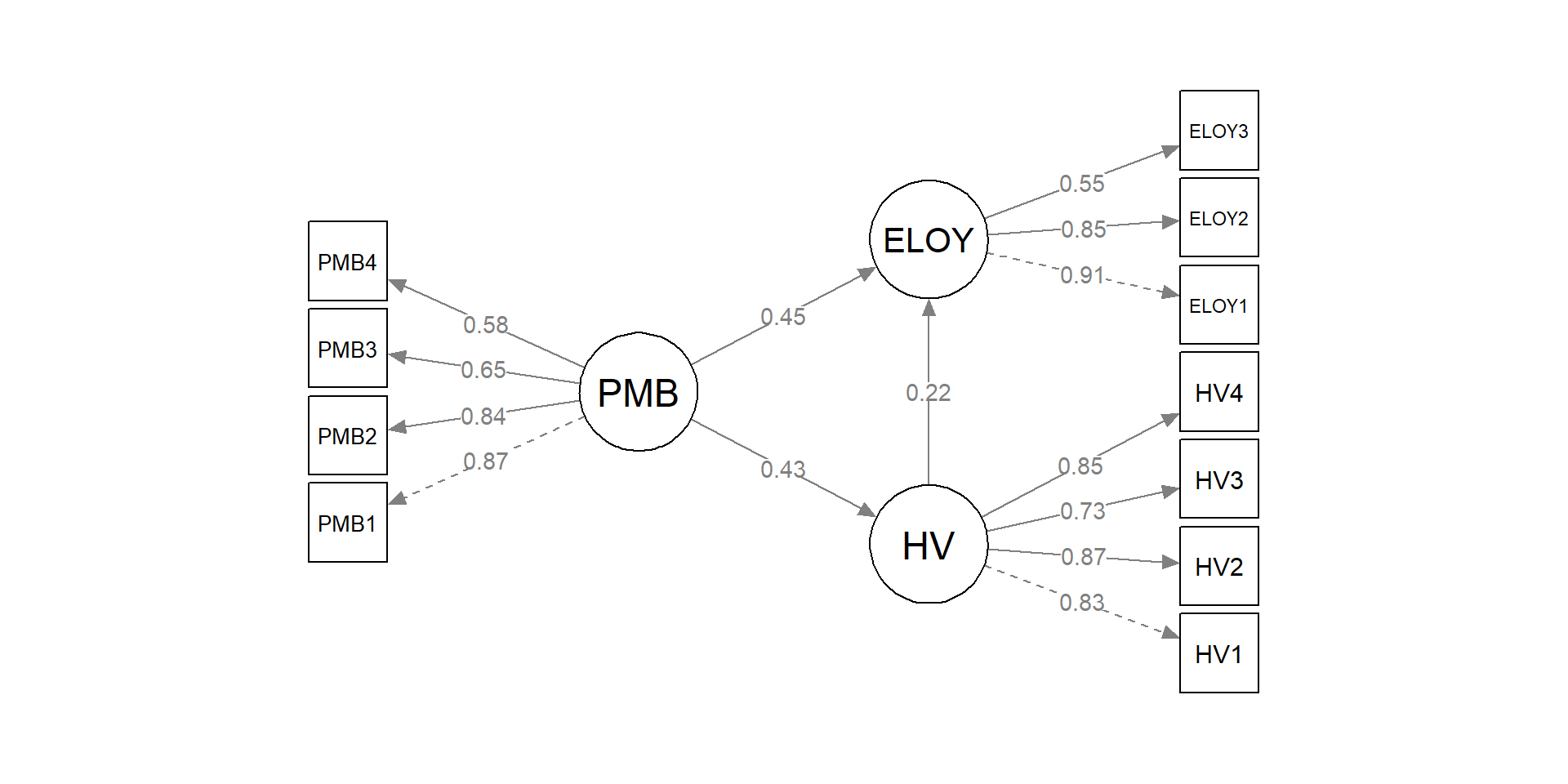
Data E-Loyalty (Khoa & Nguyen, 2020): PMB → HV → ELOY.
Konstruk dan Hipotesis
| Konstruk | Indikator | Deskripsi |
|---|---|---|
| PMB | PMB1–4 | Perceived Mental Benefits |
| HV | HV1–4 | Hedonic Value |
| ELOY | ELOY1–3 | Electronic Loyalty |
| No | Hipotesis | Path |
|---|---|---|
| H1 | PMB → ELOY | ELOY ~ PMB |
| H2 | PMB → HV | HV ~ PMB |
| H3 | HV → ELOY | ELOY ~ HV |
Sintaks lavaan
| Operator | Makna | Contoh |
|---|---|---|
=~ |
“diukur oleh” | PMB =~ PMB1 + PMB2 |
~ |
“diregresikan terhadap” | ELOY ~ PMB + HV |
~~ |
kovarians/varians | HV ~~ ELOY |
:= |
defined parameter | indirect := a*b |
CFA: Spesifikasi & Estimasi
Fit Indices CFA
  chisq      df  pvalue     cfi     tli   rmsea    srmr
969.080 41.000 0.000 0.742 0.654 0.216 0.124 | Indeks | Kriteria Baik |
|---|---|
| CFI | ≥ 0.90 |
| TLI | ≥ 0.90 |
| RMSEA | ≤ 0.08 |
| SRMR | ≤ 0.08 |
Tip
Laporkan minimal CFI, RMSEA, dan SRMR. Jangan hanya mengandalkan satu indeks.
Modification Indices
| lhs | op | rhs | mi | epc | sepc.lv | sepc.all | sepc.nox | |
|---|---|---|---|---|---|---|---|---|
| 57 | PMB1 | HV4 | 134.385 | -0.115 | -0.115 | -0.769 | -0.769 | |
| 45 | ELOY | =~ | PMB3 | 133.769 | -0.492 | -0.390 | -0.571 | -0.571 |
| 43 | ELOY | =~ | PMB1 | 109.088 | 0.433 | 0.343 | 0.466 | 0.466 |
| 35 | PMB | =~ | ELOY3 | 106.494 | 0.579 | 0.370 | 0.550 | 0.550 |
| 103 | ELOY1 | ELOY2 | 93.921 | 0.507 | 0.507 | 3.742 | 3.742 | |
| 75 | PMB3 | ELOY1 | 91.513 | -0.125 | -0.125 | -0.658 | -0.658 | |
| 66 | PMB2 | HV4 | 74.743 | 0.067 | 0.067 | 0.540 | 0.540 | |
| 61 | PMB2 | PMB3 | 64.859 | 0.092 | 0.092 | 0.588 | 0.588 | |
| 31 | PMB | =~ | HV3 | 57.716 | -0.343 | -0.219 | -0.307 | -0.307 |
| 29 | PMB | =~ | HV1 | 55.761 | 0.317 | 0.203 | 0.269 | 0.269 |
Kolom mi = penurunan chi-square jika parameter ditambahkan. Hanya tambahkan yang punya justifikasi teoretis.
Standardized Loadings
| Konstruk | Indikator | Loading | Std.Loading | p | Memadai |
|---|---|---|---|---|---|
| PMB | PMB1 | 1.000 | 0.868 | NA | Ya |
| PMB | PMB2 | 0.733 | 0.841 | 0 | Ya |
| PMB | PMB3 | 0.698 | 0.652 | 0 | Ya |
| PMB | PMB4 | 0.558 | 0.577 | 0 | Ya |
| HV | HV1 | 1.000 | 0.828 | NA | Ya |
| HV | HV2 | 0.991 | 0.873 | 0 | Ya |
| HV | HV3 | 0.840 | 0.734 | 0 | Ya |
| HV | HV4 | 1.049 | 0.847 | 0 | Ya |
| ELOY | ELOY1 | 1.000 | 0.908 | NA | Ya |
| ELOY | ELOY2 | 0.741 | 0.847 | 0 | Ya |
| ELOY | ELOY3 | 0.464 | 0.546 | 0 | Ya |
Loading ≥ 0.50 memadai, idealnya ≥ 0.70.
CR & AVE
std_loadings <- parameterEstimates(cfa_fit, standardized = TRUE) |>
  filter(op == "=~") |> select(lhs, std.all)

reliabilitas <- std_loadings |>
  group_by(Konstruk = lhs) |>
  summarize(
    n_items = n(),
    AVE = sum(std.all^2) / n(),
    CR = sum(std.all)^2 / (sum(std.all)^2 + (n() - sum(std.all^2))),
    .groups = "drop"
  )
reliabilitas |> kable(digits = 3)| Konstruk | n_items | AVE | CR |
|---|---|---|---|
| ELOY | 3 | 0.613 | 0.820 |
| HV | 4 | 0.676 | 0.893 |
| PMB | 4 | 0.555 | 0.829 |
AVE ≥ 0.50 (convergent validity), CR ≥ 0.70 (reliabilitas).
Discriminant Validity: Fornell-Larcker
       PMB    HV  ELOY
PMB  1.000
HV   0.434 1.000
ELOY 0.548 0.413 1.000 ELOY HV PMB
0.783 0.822 0.745 √AVE harus > korelasi antar konstruk pada baris/kolomnya.
Model Tanpa Mediasi
Full SEM dengan Mediasi
Label a, b, c untuk menghitung indirect & total effect.
Estimasi Bootstrap
Bootstrap: distribusi sampling mediasi umumnya skewed → CI empiris lebih valid.
Path Coefficients
| DV | IV | B | SE | p | Beta | Sig |
|---|---|---|---|---|---|---|
| HV | PMB | 0.424 | 0.081 | 0 | 0.434 | Ya |
| ELOY | PMB | 0.564 | 0.116 | 0 | 0.454 | Ya |
| ELOY | HV | 0.275 | 0.067 | 0 | 0.216 | Ya |
R² & Mediasi
 PMB1  PMB2  PMB3  PMB4   HV1   HV2   HV3   HV4 ELOY1 ELOY2 ELOY3    HV  ELOY
0.754 0.708 0.426 0.333 0.685 0.763 0.539 0.718 0.824 0.717 0.298 0.188 0.339 | Label | Estimate | p | CI.Lower | CI.Upper |
|---|---|---|---|---|
| indirect | 0.116 | 0.003 | 0.054 | 0.203 |
| total | 0.680 | 0.000 | 0.491 | 0.841 |
CI tidak melewati nol → mediasi signifikan. Efek langsung tetap signifikan → mediasi parsial.
Path Diagram
Bagian B: PLS-SEM dengan seminr
Mengapa PLS-SEM?
- Tidak memerlukan asumsi normalitas
- Sampel kecil (>50)
- Mendukung indikator formatif dan reflektif
- Cocok untuk model kompleks
- Fokus pada prediksi
Reflektif vs Formatif
- Reflektif (Mode A): Indikator = efek dari konstruk. Hapus satu → makna tetap.
- Formatif (Mode B): Indikator membentuk konstruk. Hapus satu → makna berubah.
Tipe Konstruk di seminr
| Fungsi | Model | Penjelasan |
|---|---|---|
composite() |
Composite Mode A | Default PLS-SEM, correlation weights |
composite(..., mode_B) |
Composite Mode B | Formatif, regression weights |
reflective() |
Common factor | PLSc (consistent PLS) |
higher_composite() |
HOC | Dibentuk dari dimensi konstruk lain |
single_item() |
Single item | Satu indikator |
Dataset & Model
| Konstruk | Indikator | Tipe |
|---|---|---|
| Image | IMAG1–3 | composite Mode A |
| Value | PERV1–2 | composite Mode A |
| Satisfaction | HOC | higher_composite (Image + Value) |
| Quality | PERQ1–3 | composite Mode B (formatif) |
| Complaints | CUSCO | single_item |
| Loyalty | CUSL1–3 | reflective (PLSc) |
Hipotesis PLS
| No | Hipotesis | Path |
|---|---|---|
| H1 | Quality → Satisfaction | |
| H2 | Satisfaction → Complaints | |
| H3 | Satisfaction → Loyalty |
Mediasi: Quality → Satisfaction → Loyalty
Spesifikasi Model
mm <- constructs(
  composite("Image",        multi_items("IMAG", 1:3)),
  composite("Value",        multi_items("PERV", 1:2)),
  higher_composite("Satisfaction",
                   dimensions = c("Image", "Value"),
                   method = two_stage),
  composite("Quality",      multi_items("PERQ", 1:3), weights = mode_B),
  composite("Complaints",   single_item("CUSCO")),
  reflective("Loyalty",     multi_items("CUSL", 1:3))
)

sm <- relationships(
  paths(from = "Quality",      to = "Satisfaction"),
  paths(from = "Satisfaction", to = c("Complaints", "Loyalty"))
)
Estimasi PLS
pls_model <- estimate_pls(
  data = as.data.frame(mobi),
  measurement_model = mm,
  structural_model = sm
)

# Workaround bug seminr: HOC dimensions
hoc_dims <- c("Image", "Value")
stage1_scores <- pls_model$first_stage_model$construct_scores
pls_model$rawdata <- cbind(pls_model$rawdata,
                           stage1_scores[, hoc_dims, drop = FALSE])

pls_summary <- summary(pls_model)
Reliabilitas
             alpha  rhoC   AVE  rhoA
Quality      0.718 0.836 0.633 1.000
Satisfaction 0.640 0.847 0.735 0.641
Complaints   1.000 1.000 1.000 1.000
Loyalty      0.472 0.580 0.368 0.715
Image        0.514 0.754 0.512 0.555
Value        0.824 0.918 0.848 0.861

Alpha, rhoC, and rhoA should exceed 0.7 while AVE should exceed 0.5
rhoC ≥ 0.70, AVE ≥ 0.50. Alpha/rhoA tidak relevan untuk konstruk formatif (Mode B).
Outer Loadings
      Quality Satisfaction Complaints Loyalty Image Value
Image   0.000        0.866      0.000   0.000 0.000 0.000
Value   0.000        0.848      0.000   0.000 0.000 0.000
PERQ1   0.882        0.000      0.000   0.000 0.000 0.000
PERQ2   0.673        0.000      0.000   0.000 0.000 0.000
PERQ3   0.818        0.000      0.000   0.000 0.000 0.000
CUSCO   0.000        0.000      1.000   0.000 0.000 0.000
CUSL1   0.000        0.000      0.000   0.638 0.000 0.000
CUSL2   0.000        0.000      0.000   0.160 0.000 0.000
CUSL3   0.000        0.000      0.000   0.820 0.000 0.000
IMAG1   0.000        0.000      0.000   0.000 0.832 0.000
IMAG2   0.000        0.000      0.000   0.000 0.720 0.000
IMAG3   0.000        0.000      0.000   0.000 0.569 0.000
PERV1   0.000        0.000      0.000   0.000 0.000 0.900
PERV2   0.000        0.000      0.000   0.000 0.000 0.941
Loading ≥ 0.70 ideal. Loading 0.40–0.70: pertimbangkan dampak pada AVE.
HTMT (Discriminant Validity)
             Quality Satisfaction Complaints Loyalty Image Value
Quality            .            .          .       .     .     .
Satisfaction   1.011            .          .       .     .     .
Complaints     0.567        0.549          .       .     .     .
Loyalty        0.866        0.947      0.561       .     .     .
Image          1.060        1.491      0.534   0.812     .     .
Value          0.667        1.177      0.387   0.797 0.720     .
HTMT < 0.90 memadai (konservatif: < 0.85). Image–Satisfaction dan Value–Satisfaction tinggi karena mereka dimensi HOC.
Bootstrap
Tip
Minimal nboot = 5000 untuk hasil stabil (Hair et al., 2019). 100 hanya untuk demo.
Path Coefficients (Bootstrap)
                             Original Est. Bootstrap Mean Bootstrap SD T Stat.
Quality  ->  Satisfaction            0.867          0.878        0.066  13.059
Satisfaction  ->  Complaints         0.549          0.544        0.075   7.306
Satisfaction  ->  Loyalty            0.838          0.853        0.096   8.692
                             2.5% CI 97.5% CI
Quality  ->  Satisfaction      0.760    0.991
Satisfaction  ->  Complaints   0.390    0.662
Satisfaction  ->  Loyalty      0.665    1.072
T > 1.96 dan CI tidak melewati nol → signifikan.
R² dan f²
             Satisfaction Complaints Loyalty
R^2                 0.752      0.302   0.702
AdjR^2              0.751      0.299   0.701
Quality             0.867          .       .
Satisfaction . 0.549 0.838| R² | Interpretasi |
|---|---|
| ≥ 0.75 | Substansial |
| ≥ 0.50 | Moderat |
| ≥ 0.25 | Lemah |
             Quality Satisfaction Complaints Loyalty
Quality        0.000        3.035      0.000   0.000
Satisfaction   0.000        0.000      0.432   2.355
Complaints     0.000        0.000      0.000   0.000
Loyalty        0.000        0.000      0.000   0.000
f²: 0.02 kecil, 0.15 sedang, 0.35 besar.
Mediasi PLS-SEM
 Original Est. Bootstrap Mean   Bootstrap SD        T Stat.        2.5% CI
     0.7266103      0.7532250      0.1293329      5.6181415      0.5174600
      97.5% CI
1.0304410 PLSpredict
# PLSpredict belum mendukung higher_composite()
# Demo dengan model sederhana tanpa HOC:
mm_simple <- constructs(
  composite("Quality",      multi_items("PERQ", 1:3), weights = mode_B),
  composite("Satisfaction", multi_items("IMAG", 1:3)),
  composite("Complaints",   single_item("CUSCO")),
  reflective("Loyalty",     multi_items("CUSL", 1:3))
)
sm_simple <- relationships(
  paths(from = "Quality",      to = "Satisfaction"),
  paths(from = "Satisfaction", to = c("Complaints", "Loyalty"))
)
pls_simple <- estimate_pls(data = as.data.frame(mobi),
                           measurement_model = mm_simple,
                           structural_model = sm_simple)
set.seed(2026)
pred <- predict_pls(pls_simple, technique = predict_DA, noFolds = 10)
summary(pred)
PLS in-sample metrics:
     IMAG1 IMAG2 IMAG3 CUSCO CUSL1 CUSL2 CUSL3
RMSE 1.489 1.414 2.058 2.105 2.525 2.829 2.006
MAE  1.081 1.047 1.547 1.595 1.910 2.387 1.474

PLS out-of-sample metrics:
     IMAG1 IMAG2 IMAG3 CUSCO CUSL1 CUSL2 CUSL3
RMSE 1.504 1.446 2.075 2.137 2.564 2.848 2.034
MAE  1.090 1.065 1.561 1.621 1.940 2.401 1.487

LM in-sample metrics:
     IMAG1 IMAG2 IMAG3 CUSCO CUSL1 CUSL2 CUSL3
RMSE 1.432 1.327 1.980 2.039 2.494 2.816 1.973
MAE  1.044 0.997 1.482 1.579 1.915 2.378 1.481

LM out-of-sample metrics:
     IMAG1 IMAG2 IMAG3 CUSCO CUSL1 CUSL2 CUSL3
RMSE 1.458 1.367 2.022 2.090 2.548 2.874 2.014
MAE  1.059 1.025 1.511 1.624 1.955 2.430 1.502

Construct Level metrics:
        Satisfaction Complaints Loyalty
IS_MSE        0.6161     0.8578   0.854
IS_MAE        0.5785     0.7019   0.656
OOS_MSE       0.6373     0.8721   0.878
OOS_MAE       0.5854     0.7073   0.665
overfit       0.0343     0.0167   0.028
PLS RMSE < LM RMSE → predictive power baik.
Path Diagram PLS
Rekap Sesi 3
Perbandingan Praktis
| Aspek | CB-SEM (lavaan) |
PLS-SEM (seminr) |
|---|---|---|
| Sintaks | =~, ~ |
constructs(), relationships() |
| Estimasi | cfa() / sem() |
estimate_pls() |
| Signifikansi | Langsung dari output | bootstrap_model() |
| Fit indices | CFI, TLI, RMSEA, SRMR | R², f², HTMT |
| Mediasi | Label + := |
specific_effect_significance() |
Yang Sudah Dipelajari
- Konsep SEM: laten vs manifes, measurement vs structural
- CB-SEM: CFA → Full SEM, fit indices, CR, AVE, Fornell-Larcker, mediasi
- PLS-SEM: composite (Mode A/B), reflective (PLSc), HOC, single_item, bootstrap, R², f², HTMT
Latihan
Latihan 1: CB-SEM
Hapus path
ELOY ~ HVdan estimasi ulang.
Latihan 2: PLS-SEM
Hapus CUSL2 dari Loyalty, estimasi ulang. Apakah reliabilitas membaik?
Jawaban
mm2 <- constructs(
  composite("Image",        multi_items("IMAG", 1:3)),
  composite("Value",        multi_items("PERV", 1:2)),
  higher_composite("Satisfaction",
                   dimensions = c("Image", "Value"),
                   method = two_stage),
  composite("Quality",      multi_items("PERQ", 1:3), weights = mode_B),
  composite("Complaints",   single_item("CUSCO")),
  reflective("Loyalty",     c("CUSL1", "CUSL3"))
)
pls_model2 <- estimate_pls(
  data = as.data.frame(mobi),
  measurement_model = mm2,
  structural_model = sm
)
stage1 <- pls_model2$first_stage_model$construct_scores
for (d in c("Image", "Value")) {
  pls_model2$rawdata[[d]] <- stage1[, d]
}
summary(pls_model2)$reliability
alpha rhoC AVE rhoA
Quality 0.718 0.837 0.633 1.000
Satisfaction 0.640 0.847 0.735 0.641
Complaints 1.000 1.000 1.000 1.000
Loyalty 0.703 0.714 0.559 0.733
Image 0.514 0.754 0.512 0.556
Value 0.824 0.918 0.848 0.866
Alpha, rhoC, and rhoA should exceed 0.7 while AVE should exceed 0.5Akhir Sesi 3!
Terima kasih atas partisipasinya!